







 Your interview is ready
Product Manager interview · AI-led. Five short topics, start whenever you like.
Collaboration Case Study
The interview rules nobody tells you about
Candidates guess the rules of an AI interview while it is already running, so they cut the part of an answer that sets them apart.


What this study is about
Not a visual redesign. It decides what an AI interview has to tell you before it starts scoring you.
TypeSelf-initiated UX study
CategoryHR & recruiting SaaS, specifically AI-led interviews recorded as audio or video
ScopeUX research and interaction design
Problem
Guessing the rules while being judged
Candidates have to guess the rules of an evaluation while that evaluation is already running.
Who is affected?Job seekers with a single attempt at an AI-led interview, recorded as audio or video.
What don’t they know?They start without knowing what is measured, how long it runs, whether retakes are allowed, whether a human reviews it, or whether a pause will end the answer.
When does it apply?From the invitation to the first answer, then at every pause. Some only realise mid-interview that the interviewer is not a person.
Where is the gap?On the interview screen. The rules do exist, but in help centres and documentation, outside the flow.
Why does it happen?Silence-based end-of-turn detection is systematically wrong, and nothing on screen tells candidates it exists.
How do they cope?They work around it alone: staying silent while thinking, asking for the question again, shortening answers, withdrawing.
In their own words
“There was so much text that by the time I finished reading all the info the time was already too tight.”
“I have no way to know the exact time I will finally get reviewed by a Human proctor.”
“I lost one question by thinking out loud.”
Those workarounds are exactly what make candidates perform below their actual ability.
Research
Our first assumption was wrong
We expected “cut off mid-answer” to lead. In the data it ranks third.
One primary theme per account, drawn from public candidate accounts across many source types, March 2024 to October 2026. Positive accounts are not shown.
The problem is not evenly felt. A smaller share of accounts was positive. Some found the pause generous, others found a uniform interview fairer. Whatever we add has to stay light for them.
User persona
Built from patterns repeating across 116 candidate accounts, not from one person.
Ari
The candidate with one shot
Intern to managing director
Audio or video interview
One attempt, no retake
Goals
- Show their full ability in one attempt that cannot be repeated
- Know who evaluates, what is measured, and whether a human sees it
- Pause to think, and fix a slip, without starting over
Behaviours
- Shortens and flattens answers to fit the time and read cleanly to a machine
- Thinks silently instead of aloud, because pauses feel risky
- Invents their own tactics: repeats, re-records, a second AI in another tab
Pain points
- Rules never stated before the interview
- Time pressure that forces answers to be cut
- Cut off while thinking
- Accent or name misheard
- No idea whether a human reviews the recording
Touchpoints
- Invitation email
- Waiting room
- Answer area
- Help centre
Root cause
Two roots. Only one can be designed
One is technical and already measured in the literature. The other is not technical at all, and it is the one design can close.
Technical branchNot ours to fix
- Why can a pause end a candidate’s turn?
Spoken systems treat roughly 1 to 2 seconds of silence as the end of a turn.
- Why is that silence threshold wrong?
Pauses inside a turn are longer than pauses between turns. Human transitions take 200 to 250 ms; within-turn pauses run 400 to 1,000 ms. The threshold sits in between, so thinking gets read as “finished”.
- Why not fix it with a better model?
The gap is already measured. Silence-based detection takes the turn on 37.1% of user pauses, against 15.9% between humans, about 2.3× more often.
- Why don’t the candidate’s own cues help?
Fillers like “um” do not hold the turn at the onset of silence; the effect only starts after 1.2 s. Vendor advice to “keep talking” leans on a cue that fails when it matters.
Design branchWhere design works
- Why don’t candidates know the rules exist?
They sit in vendor documentation, not in the flow. One vendor tells candidates to avoid long pauses and to tell the AI themselves if cut off. Another explains what is measured, but to employers, not to candidates.
- Why is that harmful, not just annoying?
It changes behaviour while the interview is running. Candidates censor nuance, afraid a pause will read as unprepared.
Design cannot move the threshold. It can tell candidates that the threshold exists, who evaluates them, and what is measured.
Four ways candidates patch a missing rulebook
They guess the rules, then change how they speak to survive that guess. The change itself is what makes them come across as less capable than they are.
P1
Patching a missing rulebook with private strategy
With nothing explained, they invent their own tactics: lighting, background, clothing, how they close an answer.
P2
Shortening and flattening answers
They drop nuance and trim the story so it fits the time and reads cleanly to a machine.
P3
Thinking silently instead of thinking aloud
Once they learn pauses are risky, they suppress the audible part of their reasoning.
P4
A split reaction along self-image
Candidates who see their strength as non-cognitive are the ones who object most. Those who feel cognitively strong accept an AI evaluation more readily.
Journey & insight
Friction stacks up from the invitation to the wait for a result
Five stages, with the design opportunity each one opens.
| 1Invitation | 2Preparation | 3Answering | 4Repairing | 5Waiting | |
|---|---|---|---|---|---|
| Feeling |
😕Unfamiliar😧Pressured😣Frustrated😵💫Confused😟Anxious
| ||||
| Thought | “this was my first conversation with an AI bot, so it was quite strange.” | “by the time I finished reading all the info the time was already too tight.” | “I lost one question by thinking out loud.” | “Time management and their second chances during retake interview” | “I have no way to know the exact time I will finally get reviewed” |
| Does | Opens the link, often not knowing an AI will evaluate | Checks devices while reading a long instruction screen | Answers while guessing the right length and whether pausing is safe | Looks for a way to say “I’m not finished” | Waits, not knowing when or by whom |
| Pain | AI not disclosed up front | The clock runs while they read | Rules unclear and cut off while thinking | No standard way to repair an answer | No idea whether a human reviews it |
| Touchpoint | Invitation email and link | Waiting room, device check, instructions | Answer area with AI audio or video | Re-record option, vendor help centre | No review-status screen exists |
| Opportunity | Disclose AI, duration and question count | S1Four-line rule card, no countdown | S2 + S4Turn cue and live transcript | S3Correct it out loud, mid-answer | S5Stated review status |
Key insight
The problem is not that the AI cuts people off. Candidates have to guess the rules of an evaluation while it is already running, so they trim exactly the part of an answer that sets them apart.
Three assumptions the data broke
We assumed: The biggest complaint is being cut off mid-answer.
It ranks third, with 16 accounts. The largest theme is not knowing the rules, with 21. Being cut off is real, but it is a symptom: candidates do not know there is a rule they can break.
We assumed: The answer is to explain more.
Detailed explanation can lower perceived fairness. It raises the fairness of the process but lowers the fairness of the outcome, by promising a precision the decision never delivers. A meta-analysis covering 24,578 respondents never tested transparency at all, so the claim was never actually tested.
We assumed: The solution is an “I’m not finished” button.
Explicit mechanisms like this are failure-prone and feel rigid, and saying the equivalent out loud reads as rude in human conversation. In one study, a spoken phrase meant to hold the turn failed in 4 of 47 trials.
So the direction is not “explain more”, and not “add a button”. It is to reduce uncertainty about the procedure without promising precision, and give control that is limited, with its limits visible.
Problem statement
Job seekers want to show their full ability in one attempt that cannot be repeated. What stands in the way is not the AI, but four things that are never stated on screen:
- Who evaluates, and whether a human will see it
- What is actually measured
- How pauses and silence are interpreted
- Whether and how an answer can be repaired
Not knowing, they guess, and the safe guess is to shorten, flatten and hold back. For the product, the cost arrives before any signal is collected: candidates withdraw before the first question.
How might we
help candidates know enough of the rules to answer as themselves, without over-explaining and without rigid controls, so fewer withdraw before answering and fewer censor their own answers?
Solution
The Turn Contract
Before the first question, the interview states four rules about turns and evaluation, and no more. While the candidate answers, the screen shows which rule is in force, so pausing stops being a gamble. A live transcript shows what the system heard, flags what it missed, and lets the candidate correct it out loud before the turn ends.
S1Four-line rule card
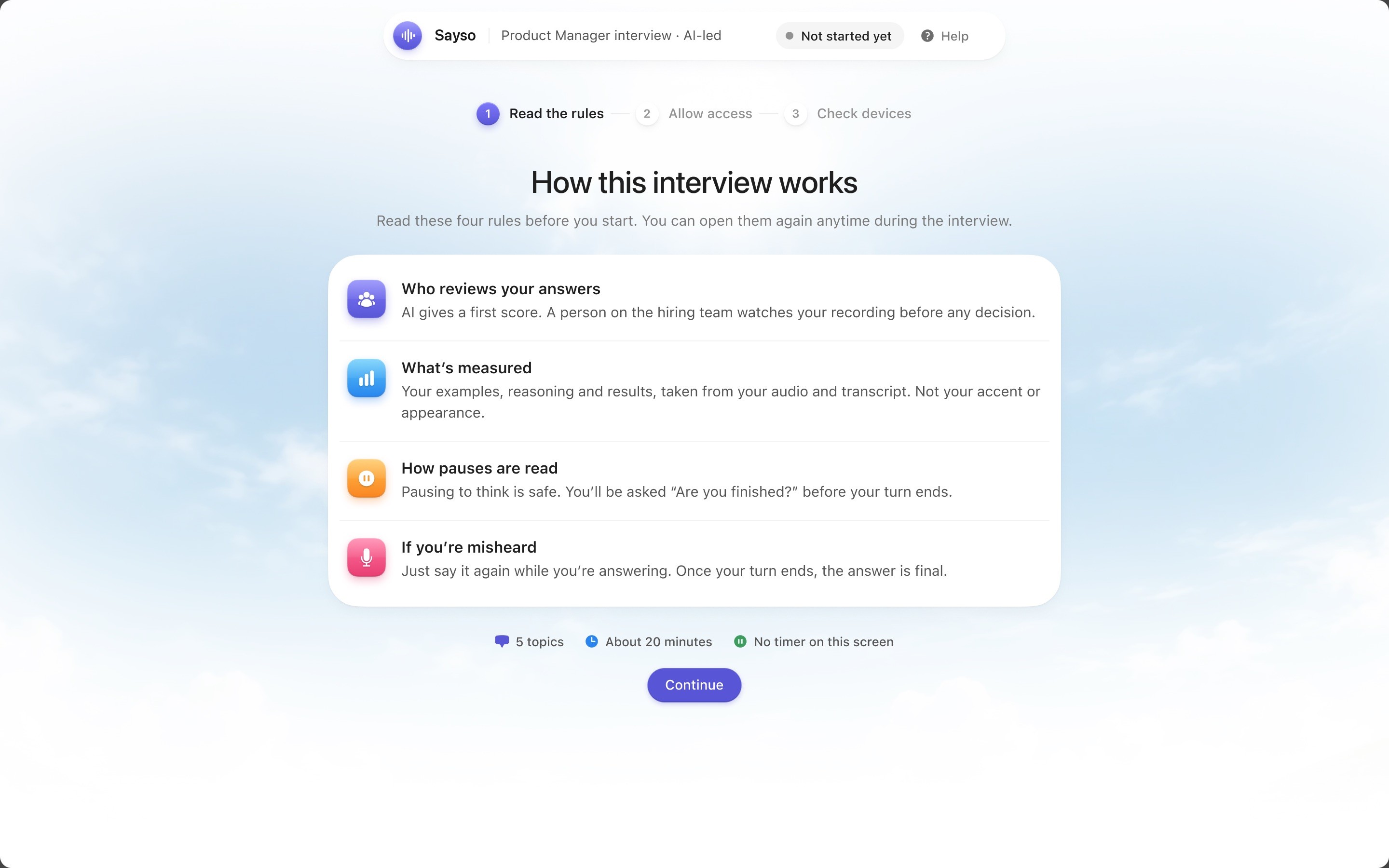
Shown right before the first question: who evaluates and whether a human sees it, what is measured, how silence is read, how an answer can be repaired. Four lines maximum, no algorithm explainer.
S2A turn cue that reads as behaviour
When the candidate goes quiet, a “still listening” cue appears as behaviour, not a loading icon. The threshold only surfaces as it is about to be reached.
S3Live correction, out loud
If the transcript shows a wrong word, the candidate fixes it in the moment by saying “I didn’t mean X, I meant Y.” No re-record, no starting over. Once the turn ends, the answer is final.
S4Live transcript
What the system captures appears as text while the candidate speaks. Anything it did not catch is highlighted, with a prompt to say it again, so mishearings surface while they can still be fixed.
S5Stated review status
At the end: whether a human will review it, roughly when, and what happens next. If no human is involved, that is stated too, ideally at the start.
User flow
The change concentrates before the first question, during the turn, and at the end. Four of five screens carry a piece of the contract, and no new step is added anywhere the flow already works.
1
Invitation
AI leads and evaluates, expected duration, question count, and the four rule areas
Action: Start interview
2
Waiting room & rule card
Device status and no countdown, so the candidate starts only once genuinely ready
Action: I’m ready, start
S1 · Rule card3
Answer area
A “still listening” cue and a live transcript of what is being captured. Repeats per question.
Action: Speak, then finish answering
S2 · Turn cue · S4 · Transcript4
Correcting what was heard
The transcript flags a part it missed, or shows a wrong word. The candidate says it again in the moment, then keeps answering.
Action: “I didn’t mean X, I meant Y”
S3 · Live correction5
Finished
Whether a human reviews it, roughly when, and what happens next
Action: Close
S5 · Review statusWhat changes against today
1Before the first question
Today
A long instruction screen, countdown already running, evaluation rules unstated.
Proposed
A four-line rule card, no countdown, and “I’m ready” pressed when read.
S1
2During the turn
Today
A pause of a second or two can end the turn, with no signal of any kind.
Proposed
A “still listening” cue and a live transcript, so the candidate sees what is being captured.
S2S4
3When it mishears
Today
Candidates cannot see what the system heard. A misheard name or phrase is scored as if it was said.
Proposed
The transcript flags what it missed, and the candidate corrects it out loud before the turn ends.
S3S4
4Finished
Today
The candidate waits, not knowing who reviews it, when, or on what basis.
Proposed
Review status is stated: human or not, roughly when, and what happens next.
S5
Impact
Expected impact and how we would test it
Every outcome is a hypothesis. No target numbers, because there is no data to support them yet. Each one names how we would check whether it is real.
One thing decides it: how many candidates actually reach an answer, and answer in full.
| Type | Metric | How it is measured |
|---|---|---|
| Primary | Share of candidates who open the invitation and complete the first answer | Funnel from invitation link to first answer, drop-off split before and after the rule card |
| Supporting | Share of turns ended by the system while the candidate was not finished | From the audio: how often the candidate speaks again within 2 seconds of the system taking over |
| Supporting | Answer length and variety | Duration and word count, compared across those who saw the rule card and those who did not |
| Guardrail | The rule card must not make any group withdraw earlier | Drop-off per group, because stating “AI will evaluate you” up front can worsen reactions |
Per solution component
| Component | For the candidate | For the business |
|---|---|---|
| S1 · Four-line rule card | They stop guessing and stop patching with private tactics (P1), so their energy goes back into the answer. | Fewer withdraw between opening the invitation and answering the first question. |
| S2 · Turn cue | They dare to pause and think rather than suppressing their reasoning (P3). | Fewer turns ended by the system in error, so the scoring signal is more complete. |
| S3 · Live correction | A misheard word no longer costs the answer: they fix it in the moment, out loud, without starting over. | Answers are scored on what was meant, not on what was misheard, with fewer retake requests. |
| S4 · Live transcript | Candidates with an accent or a non-English name catch a mishearing while it can still be fixed (15 accounts). | Fewer public complaints that the outcome depends on the words captured, not the answer. |
| S5 · Stated review status | They stop guessing whether there is a human at the other end (13 accounts). | Candidates think less badly of the employer after a rejection. |
Prototype
UI screens
The four screens carrying the Turn Contract. Interface design by Nizar Ali.
Waiting room & rule card
 Sayso
Help
- Reopen these rules anytime during the interview.
- Pausing to think is safe.
- Misheard? Say “I didn’t mean …, I meant …”.
- 1Read the rules
- 2Allow access
- 3Check devices
How this interview works
Read these four rules before you start. You can open them again anytime during the interview.
-

Who reviews your answers
AI gives a first score. A person on the hiring team watches your recording before any decision.
-

What’s measured
Your examples, reasoning and results, taken from your audio and transcript. Not your accent or appearance.
-

How pauses are read
Pausing to think is safe. You’ll be asked “Are you finished?” before your turn ends.
-

If you’re misheard
Say “I didn’t mean …, I meant …” while you’re answering. Once your turn ends, the answer is final.
 5 topics
 About 20 minutes
 No timer on this screen
Waiting room & rule card

 sayso.com/interview
sayso.com wants to
 Use your camera
 Use your microphone
 Choose Allow
-

Nothing is recorded yet
Recording starts only after Lukas
reads a question. -

You’ll always know when it’s on
A red dot appears next to your camera whenever you’re being recorded.
-

Only the Sayso hiring team sees it
Your recording is used for this application only.
sayso.com/interview
- Camera
- Microphone
Turn both on
 Preview
-

Camera
ReadyKeep your face inside the frame.
-

Microphone
Heard youWe heard you clearly
-

Connection
StableGood enough for video
Almost ready
Lukas is ready, but your session needs one more try before you can start.
 Lukas · AI interviewerPreparing didn’t finish
-

Rules read
DoneOpen them anytime from “Interview rules” during the interview.
Interview rules
- Who reviews your answers
- What’s measured
- How pauses are read
- If you’re misheard
-

Camera and microphone checked
DoneFaceTime HD Camera · MacBook Pro Microphone
-

5 topics · about 20 minutes
Pause to think whenever you need. Each answer is final once your turn ends.
Session not ready
Answer area
 Sayso
 In progress · Topic 2 of 5
Need a hand?
- Lukas can’t hear you? Tap the mic on your camera to check it.
- Missed the question? Say “Can you repeat that?”
Topic 2 of 5
 Recording · 01:12
Interview rules
- Speak naturally. Lukas listens while you talk.
- Say “I’m done” when you finish your answer.
- Go quiet for a while and Lukas asks if you’re finished.
- Fix a wrong word by saying “I didn’t mean …, I meant …”.

 Lukas
AI interviewer
 You
 Lukas listeningYou’re muted
Topic 2 · Decision-making
Tell me about a time you had to make an important decision with incomplete information. What did you do, and what was the result?
Take your time. Say “I’m done” when you finish.
Live transcript
what the system heard you say
… I was leading the launch of a payments feature, and two days before release the test data from our partner team was still incomplete. I had to choose: delay, or roll out gradually to a small group of users first. I chose a gradual rollout because the risk could be contained, and if something broke the team could roll it back quickly…

Transcript got a word wrong? Fix it by saying:
“I didn’t mean word you see , I meant what you meant .”

Interview session
- Lukas speaking
-
Lukas listening
-
 Lukas asking · Are you finished? 18 s
-
Lukas · Answer saved
 Lukas can’t hear you
Lukas hears you

 Check your mic
 Mic is working
Pick the mic you’re talking into
Then say something. The bars should move.

Still nothing? Check your headset’s mute switch, or allow the mic in your browser.
Pick the one that hears you
Lukas can hear you now
Lukas · Answer saved
Up next · topic 3 of 5
Lukas will ask the next topic in a moment.That was the last topic. Nice work.
Correcting what was heard
 Sayso
 In progress · Topic 2 of 5
Topic 2 of 5
 Recording · 01:12

 Lukas
AI interviewer
Lukas listeningLukas paused
Topic 2 · Decision-making
Tell me about a time you had to make an important decision with incomplete information. What did you do, and what was the result?
Take your time. Say “I’m done” when you finish.
 You
Live transcriptwhat the system heard you say
… I had to choose: delay, or roll out gradually to a small group of users first.
… I chose a gradual rollout because
 the risk could be contained,
then tracked failed payments every hour.

Transcript got a word wrong? Fix it by saying:
“I didn’t mean word you see , I meant what you meant .”
Correcting what was heard
You
 Lukas paused · you’re muted
 Lukas listening
Interview rules
 Who reviews your answersAI gives a first score. A person on the hiring team watches your recording before any decision.
 What’s measuredYour examples, reasoning and results, taken from your audio and transcript. Not your accent or appearance.
 How pauses are readPausing to think is safe. You’ll be asked “Are you finished?” before your turn ends.
 If you’re misheardSay “I didn’t mean …, I meant …” while you’re answering. Once your turn ends, the answer is final.
To keep it fair
 Stay on this tab. Leaving it is noted
 Answer on your own. Other voices are noted
 Muting is fine. Lukas pauses, and mutes are noted
 Keep your face in view of the camera
A person on the hiring team reviews these notes. They never decide on their own.
Finished
Sayso
Interview complete
Thanks, Daniel. Here’s what happens next.
-
Interview submittedDone All 5 topics are saved and sent.
-
Summarized and scored by AIIn progress AI writes a summary and an initial score from your answers.
-
Checked by the hiring teamNext A person reviews your recording, transcript and the AI summary.
-
You’ll get an update by emailWithin 10 days Within 10 working days, at daniel.weber@gmail.com.
Answer summary
AI draft · a person checks it next
- 1Product senseFramed the user problem before solutions
- 2PrioritisationUsed impact vs effort, named trade-offs
- 3MetricsPicked one north-star and two guardrails
- 4StakeholdersGave a clear example of saying no
- 5Wrap-upAsked about the team’s first 90 days
Ask the hiring team
Pick a question to see the answer
Answers come straight from the hiring team’s FAQ.
Within 10 working days, by email at daniel.weber@gmail.com.
A person on the hiring team, using your recording, transcript and the AI summary.
Your answers are submitted. If something went wrong, reply to the confirmation email.
Finished
Summarized and scored by AIIn progress
AI writes a summary and an initial score from your answers.
Checked by the hiring teamNext
A person reviews your recording, transcript and the AI summary.
- Not started yet
- In progress · Topic 2 of 5
- Interview complete
- Done
- In progress
- Next
- Within 10 days
Summary
Across 116 candidate accounts and 16 papers on turn-taking and algorithmic fairness, one pattern held: the harm isn’t that an AI evaluates candidates, it’s that candidates have to guess its rules while being judged by them. The Turn Contract doesn’t move the silence threshold, it discloses it, alongside who evaluates, what is measured, and how an answer can be repaired, so candidates can spend their one attempt showing their actual ability instead of patching a rulebook they were never given.
Open to working together
Your turn.
Looking for a partner to build your product?
Wherever your product is right now, tell us. We will point you to the right person, or take it on together.
Vincentius & Nizar
Hi! I’m looking for a partner to build my product.
The concept is ready and just needs to look and feel right on screen? That’s Nizar.
Nizar AliUI Designer
Still working out the what and the why? Research, ideation and concept, that’s Vincentius.
Vincentius RanggaUX Designer
Need the whole journey? Bring us in together.
Collaborate with both